

Romeo Echo · Concept study · Munich
Listen.Understand.Support.
Out in the field, take the whole team with you — the machine that has read every manual, and the person who has actually done this before.
01 The problem
AI can do most of a job. Most is not enough.
Agents handle the common case well and fail — confidently — in the situations where failure is expensive. So the last ten per cent decides whether the other ninety can be used at all.
- 01
The failure is silent
A wrong answer arrives looking exactly like a right one. Nobody catches it until the customer does.
- 02
The escalation lands on you
Vendors route the hard case to your staff. That is the resource you were trying to free.
- 03
Pilots stall after the demo
Not because the model is weak. Because nobody wants to own what it gets wrong.
- 04
And the judgement is leaving
The people who used to absorb those cases are retiring, and taking decades of edge cases with them.
Sources: ZDFheute, 10 Oct 2026; Maginative on Klarna; Gartner; Five9 consumer report via letsdatascience (vendor survey, 3,000 consumers in the US, UK and Germany).
02 Why now
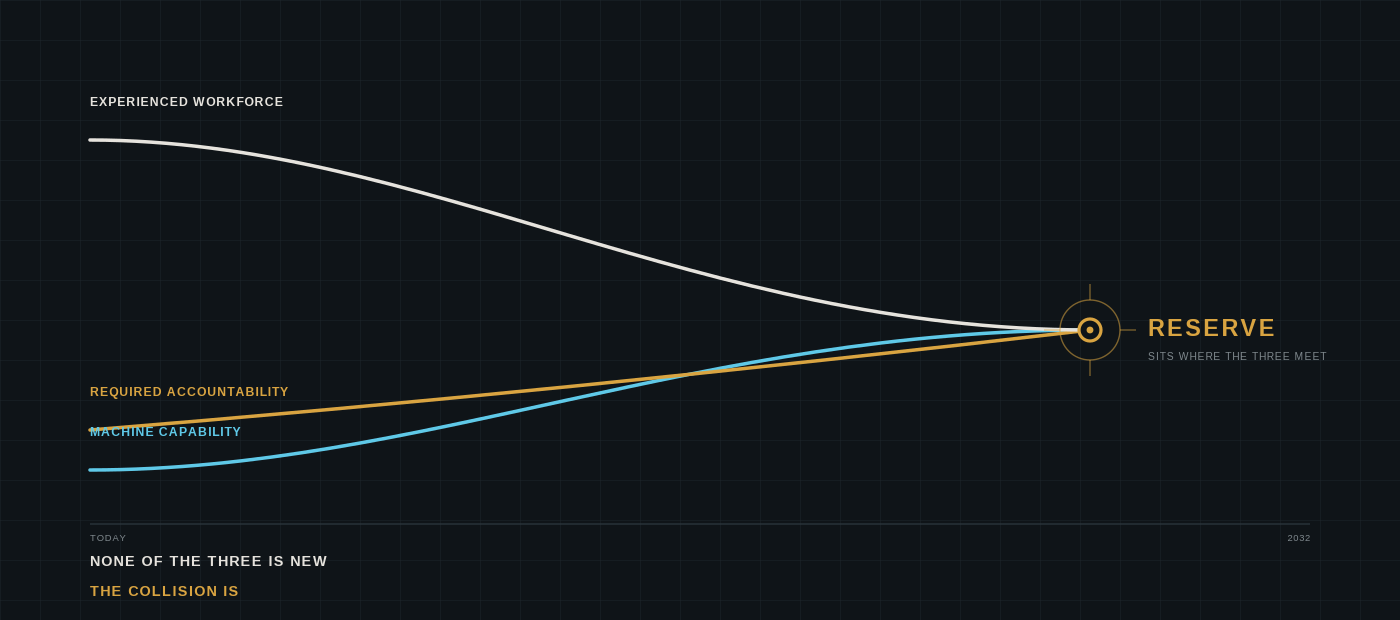
Three curves collide.
None of the three is new. The collision is. One thing changed since August: the legal deadline moved. The demand did not.
15 m
baby boomers reach retirement age in Germany by 2036 — about 1.3 million a year; the labour gap is put at 4.3 million
IW Köln · 15 Jun 2026
≈ 40 %
of office staff in German insurance are 51 or older
AGV Versicherungen · as of 31 Dec 2025
59 %
of insurance customers do not want a machine to take the final decision on their claim
Versicherungsforen Leipzig · 14 Apr 2026
12 %
accept a fully digital settlement for claims above €1,000 — the band we start in
Versicherungsforen Leipzig · 14 Apr 2026
10–30 %
of standard claims are automated at many insurers today; 58 % want 50 to 100 % by 2030
Versicherungsforen Leipzig · 14 Apr 2026
€2,000
a month tax-free for people employed beyond retirement age since January 2026 — employees only, not freelancers
Aktivrente · in force 1 Jan 2026
Sources: IW Köln; AGV, Sozialstatistische Daten 2025; Versicherungsforen Leipzig via experten.de; Human Resources Manager on the Aktivrente; Lewis Silkin on the Digital Omnibus; William Fry on the draft high-risk guidelines.
03 The product
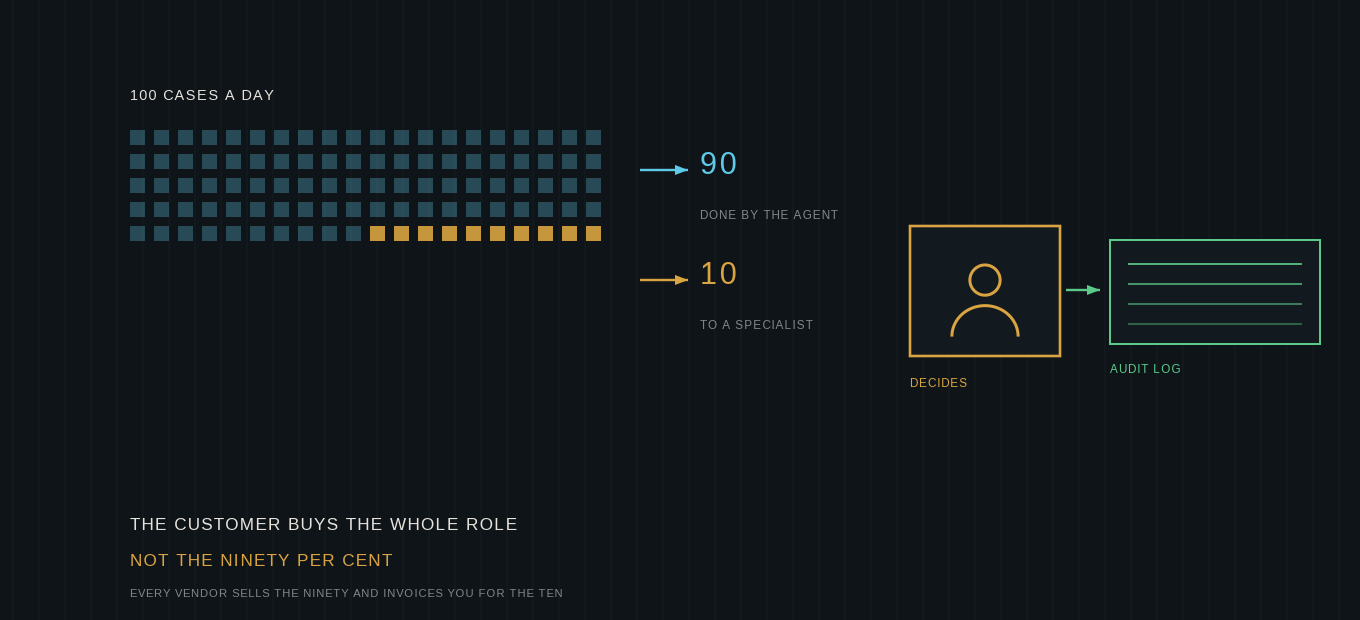
One hundred cases in. One role out.
90 % MACHINE.10 % JUDGEMENT.100 % ACCOUNTABLE.
A managed AI workforce with senior human oversight built in. You buy a role, not a licence.
04 The chain
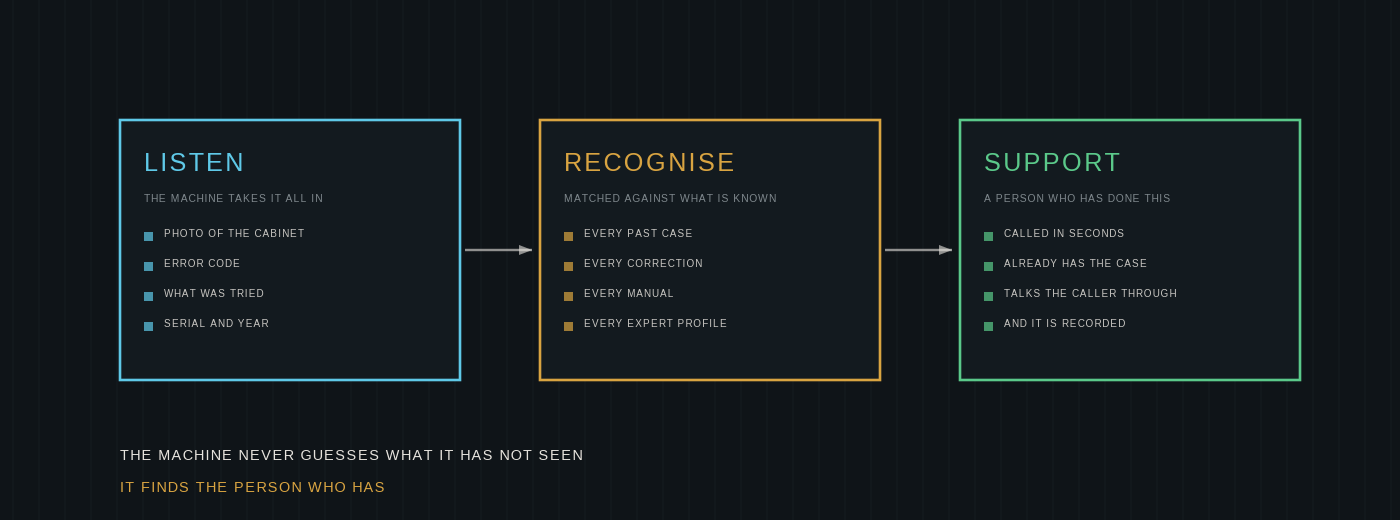
Listen. Recognise. Support.
Three steps, always the same, whether the case arrives in a queue overnight or as a photograph from someone standing in front of an open cabinet.
- 01
Listen
Photograph, error code, serial number, year of manufacture, what has already been tried. Taken in as it comes, in whatever order it comes.
- 02
Recognise
Matched against every earlier case, every correction an expert has written, every manual we hold — and against the profiles of the people who worked on that make.
- 03
Support
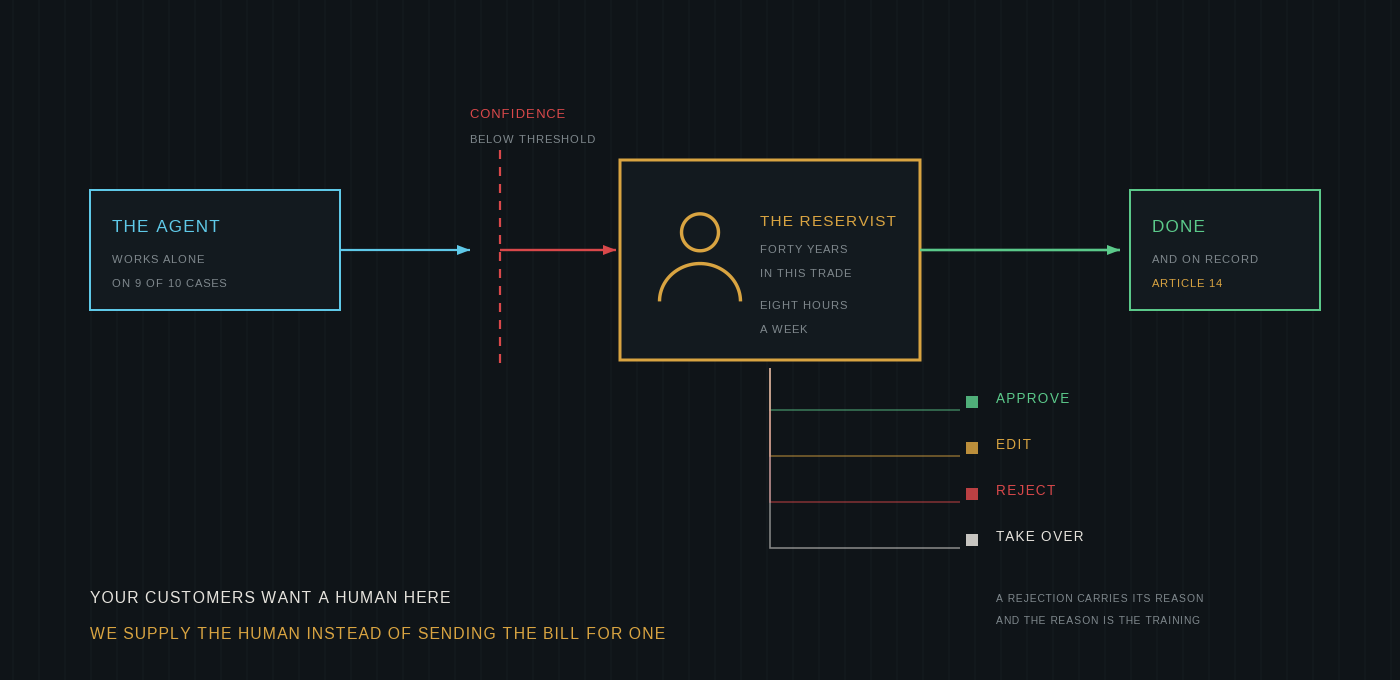
If the machine is certain, it answers. If not, the reservist on duty is called — and the whole file is already on his screen before he says hello.
- 04
And it is recorded
Question, evidence, machine proposal, human answer, result. The next caller with the same cabinet gets a faster answer because of this one.
05 Two ways it is used
Work that queues, and people who are stuck right now.
Same chain, two rhythms. One runs overnight against a backlog. The other has a person standing in the rain with a torch.
Mode one — QUEUE
Cases that arrive by themselves
Claims files, invoice discrepancies, warranty requests, permit checks. They pile up, they are documented, and nobody is waiting on the phone. The machine works the pile and a reservist signs the hard ones.
Mode two — ON CALL
Someone cannot get further
A technician at a cabinet, a shop owner with a dead till, a nurse with a pump nobody recognises. They photograph it. Within a minute they either have an answer or a person on the line who has done it before.
Why they are one product
The queue teaches the call
Every signed case in the queue becomes a match for a future call, and every call becomes a case. Two revenue lines, one growing memory.
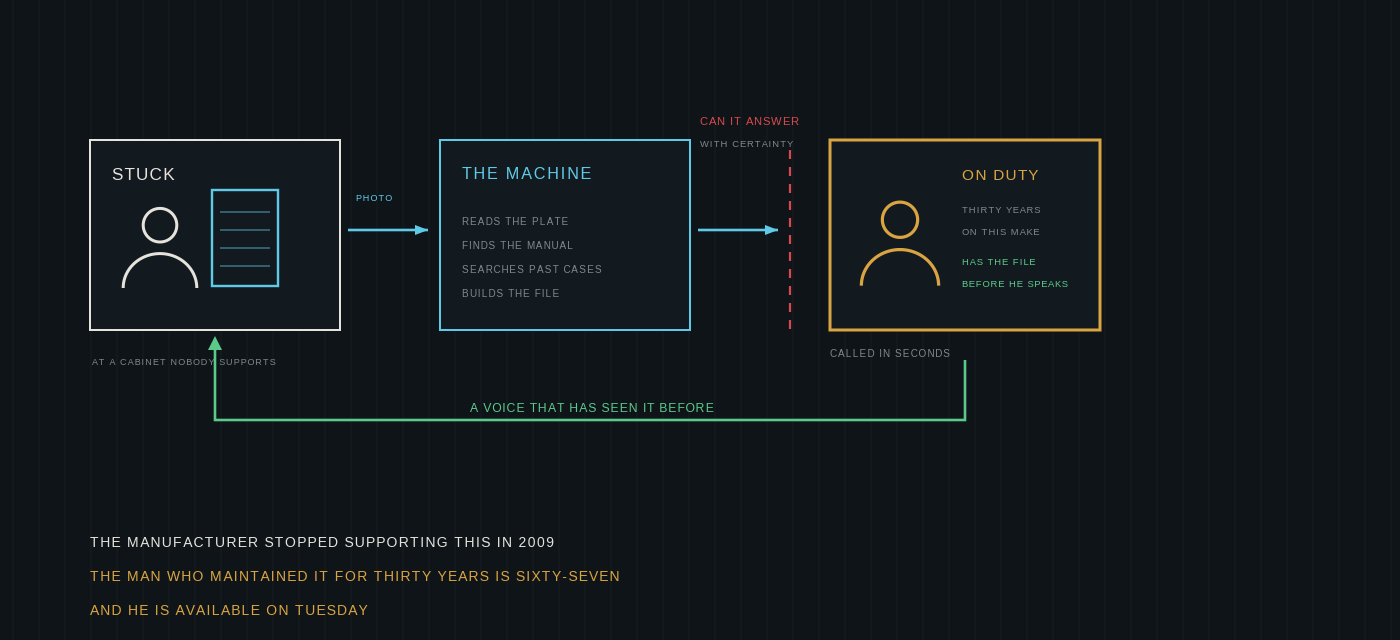
Ten calls we expect to take
01
The traffic light controller
A municipal technician opens a cabinet from the nineties. Four generations of retrofit, no wiring diagram in the folder. He photographs it. The reservist spent his career on that make.
02
The till on Saturday morning
A bakery, card payments failing, a queue at the counter. Not a hardware fault — a terminal setting changed by an update three days ago. Answered in four minutes.
03
The lift in a residential block
Controller from 1994, error code in a manual nobody has. The caretaker is not an engineer and the service company can come Thursday. The tenants cannot wait until Thursday.
04
The pump alarm at three in the morning
Small water works, one person on duty, an alarm he has never seen. He needs somebody who has, in the next ten minutes, and not a ticket number.
05
The harvester in the field
Error code, dealer closed, weather turning. Twenty minutes of downtime here is not an inconvenience, it is a day of the harvest.
06
The school heating on the first cold day
An obsolete building controller, a caretaker with a torch, four hundred children arriving at eight. The person who commissioned that system in 1998 is retired and reachable.
07
The infusion pump on a ward
A model replaced years ago and still in service. The nurse needs a certain answer, not a plausible one, and she needs to know who gave it.
08
The machine tool at shift change
A fault on a lathe older than the operator, and the only man who knew its habits left the company in 2021. He would take the call.
09
The standby generator that failed its test
A clinic, a monthly test run, a fault code. Somebody has to say tonight whether this is safe, and put their name to it.
10
The conveyor that stops every ninth pallet
Intermittent, undocumented, and it has happened before — three years ago, at another site, to somebody who wrote down what it was.


These are illustrations of the pattern, not customer stories, and the photographs are generated illustrations. What the calls have in common is the reason the pattern exists: the equipment outlived its support, and the people who understood it outlived their employment. The demand for field know-how is growing fastest exactly here: by 2029 Germany is expected to lack about 15,900 vehicle technicians, 13,800 electrical operations technicians and 13,600 mechatronics technicians (IW Köln, 7 Sep 2026).
06 How we do it
The people are the company. So this is the part that matters.
Anyone can rent a model. The question an investor should press on is where the experts come from, why they stay, and how we know what they are actually good at.
Where they come from
Channel one
Their former employer, before they leave
We approach the company that is about to lose them, not the person after they are gone. The offer is knowledge retention: your people stay reachable for your own equipment, without you re-employing anyone.
Channel two
Discontinued product lines
When a manufacturer ends support for a generation, its service organisation is dissolved. Those engineers are the only remaining source of knowledge for equipment that will run for another fifteen years.
Channel three
Guilds, chambers, and each other
Trade associations and technical societies reach exactly this cohort. And the strongest channel is the twentieth expert bringing the next five: this trade knows who was good.
Why they stay
- 01
Employed, not engaged
Part-time contract, payslip, insurance, holiday. Not an invoice from a self-employed pensioner. It costs us more and it is the reason people take it seriously. Since January 2026 it is also what makes up to €2,000 a month tax-free for someone past retirement age — the Aktivrente excludes freelancers — and fixed-term contracts with pensioners have become easier to set up.
- 02
Paid for readiness, not only for calls
A duty window is paid whether or not the phone rings. Nobody sits waiting for piecework, and nobody is punished for a quiet Tuesday.
- 03
You choose the window, and you may decline
Blocks you set yourself, weeks in advance. Declining a case has no consequence — an expert who cannot say no is not an expert, he is a queue.
- 04
Your name stays on your answer
Corrections are attributed. Standing inside the system grows with solved cases, and it is visible. After forty years of being the person everyone asked, being useful is most of the pay.

How we know what they can do
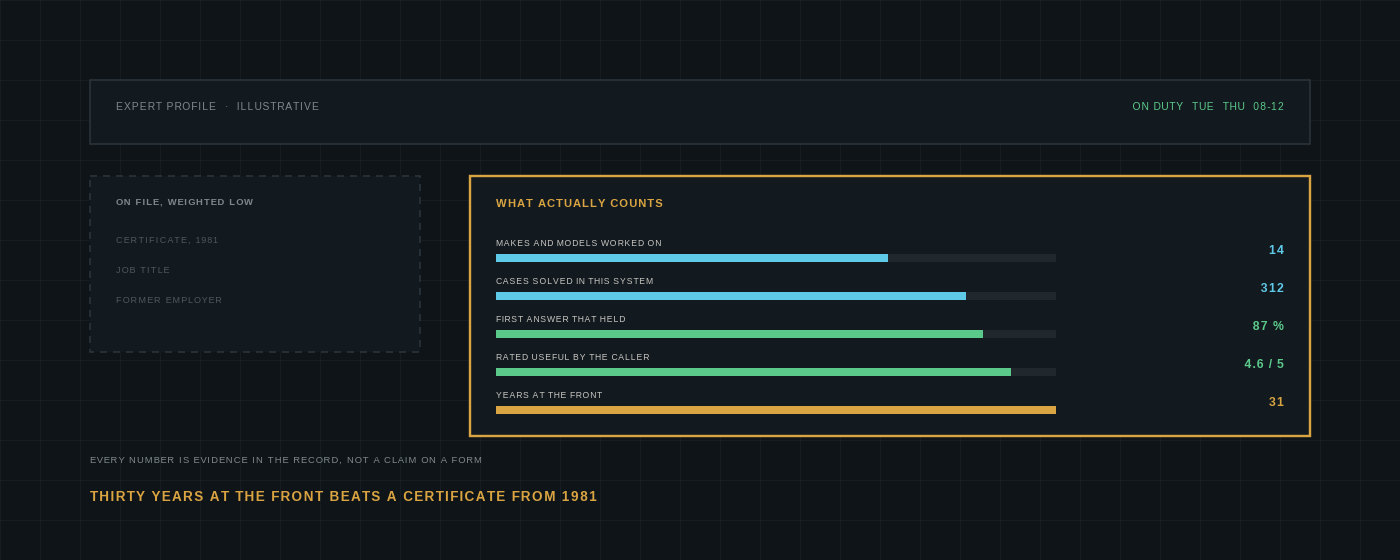
- 01
Intake is a structured interview, not a form
Which makes, which models, which years, which plant types, which era of controller. An hour with someone who knows the trade, recorded and turned into a profile.
- 02
Then it is proven case by case
Competence for a make is not claimed, it accumulates. Each solved case attaches evidence to that make, and a wrong answer subtracts from it.
- 03
The caller rates, and the rating is short
Did it work, was it quick, was it understandable. Three taps. Anything longer is not answered by someone who has just fixed a machine at two in the morning.
- 04
A wrong answer subtracts
Standing can go down. Without that the score is a participation record, and everyone in this trade knows the difference.
Where the data comes from
At the start
The customer's own history
Closed tickets, service reports, the folder in the workshop. Nothing is bought in. The first thing we do is make a company's own past legible to itself.
From the equipment
Plate, manual, parts list
Photographs of nameplates, documentation the operator already holds or licenses, spare part catalogues. Publicly available material stays clearly marked as such.
From every call
The correction and its reason
The part nobody else has: what the machine proposed, why an expert rejected it, and what worked instead. This is the layer that grows and does not decay.
Where the AI sits
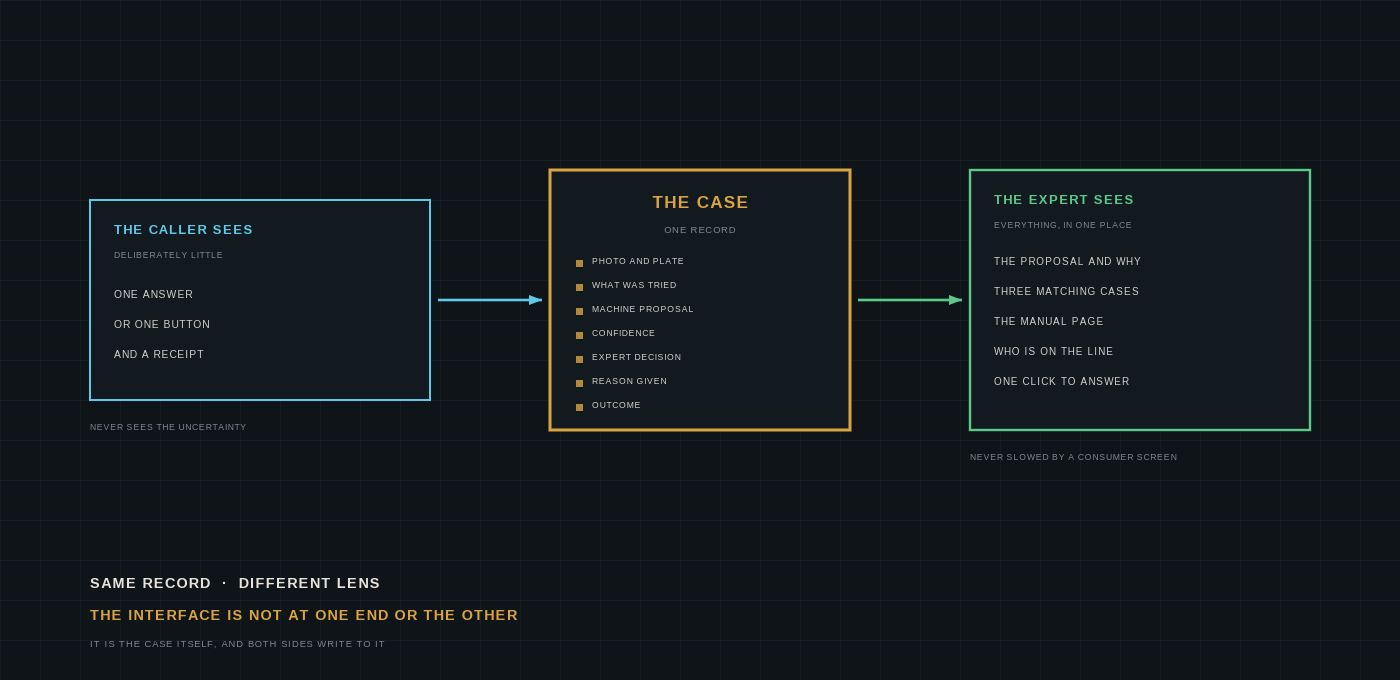
- 01
The caller sees deliberately little
One answer, or one button, and afterwards a receipt of what was decided. He must never see the machine's uncertainty, because the moment he does he stops trusting the answers that are right.
- 02
The expert sees everything at once
The proposal and its reasoning, the confidence score, the three closest past cases, the relevant manual page, and who is on the line and how experienced they are. Every second spent hunting is margin lost.
- 03
One record, written by both
Not two systems with a sync problem. The caller's photograph and the expert's decision live in the same file, which is also what the auditor eventually reads.
- 04
The customer's data never leaves his tenant
Separate storage per customer. What crosses over into the shared memory is the anonymised pattern — the fault and its fix — never the plant, the site or the name.
07 Beachhead
One role. One industry. Motor and property claims under €5,000.
We start with insurance claims operations, and with a single role: the claims handler for straightforward motor and property files.
Why this role
High volume, written down
Thousands of near-identical files a month, every decision already documented, every rule already written. The machine has something to learn from.
Why this industry
The retirement wave is worst here
Around 40 per cent of office staff in German insurance are 51 or older, and the industry association counts about a quarter of all employees as baby boomers. Replacements are not arriving. The pain is already on the board agenda.
Who signs
Head of Claims Operations
Owns the backlog, owns the cost line, owns the quality metric. Not the CIO, not innovation. The person whose numbers move on Monday.

Second and third waves, in order: technical service triage in industrial after-sales, then back-office operations at municipal utilities. Both are chosen for the same three properties, not for variety. Sources: AGV; Cash.Online citing the GDV; Versicherungsforen Leipzig.
08 Economics
The price does not move. The oversight cost does.
One role, modelled. The customer's saving is fixed on day one; our margin is what improves as escalations fall.
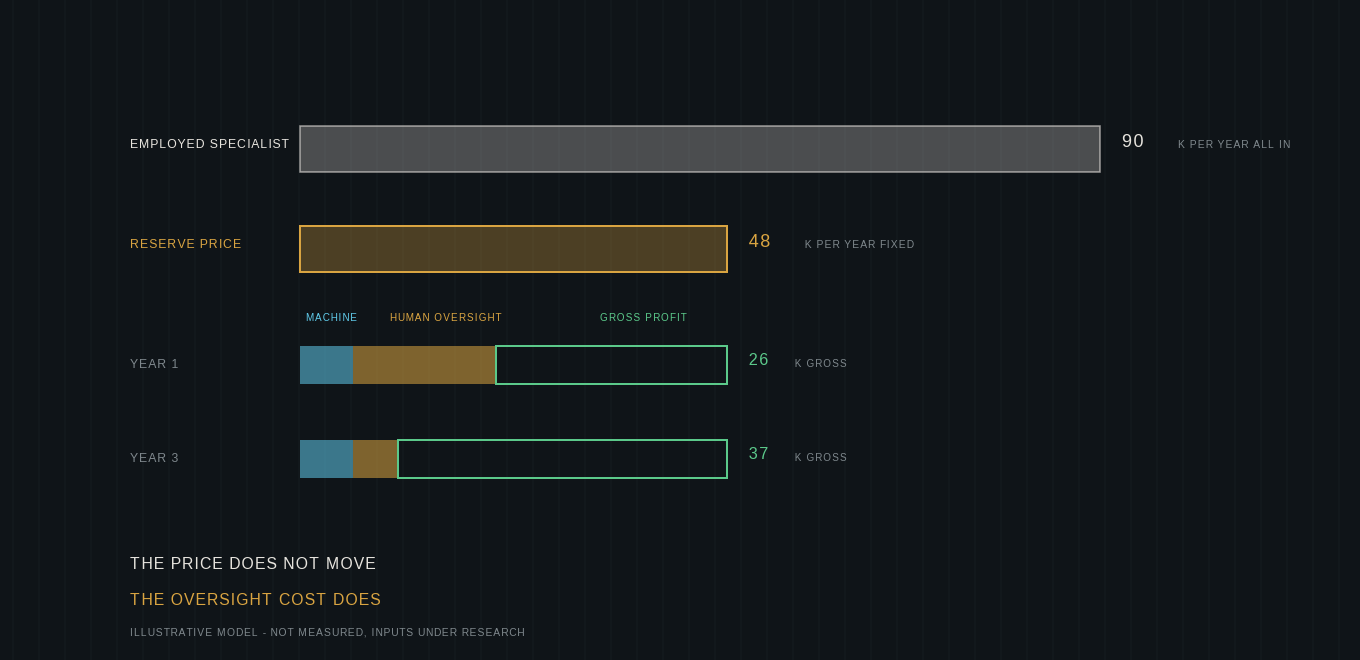
| Line | Year 1 | Year 3 | Assumption |
|---|---|---|---|
| Customer's current cost | €90k | €90k | Senior claims specialist, fully loaded employer cost |
| RESERVE price | €48k | €48k | Fixed per role, per year. Roughly half of a salary |
| Machine cost | €6k | €6k | Models, retrieval, hosting, isolated per tenant |
| Human oversight | €16k | €5k | Escalation rate falls from 30 % to 10 % as corrections accumulate |
| Gross profit | €26k | €37k | 54 % rising to 77 % |
Our model Not a forecast and not a benchmark. The purpose of publishing it is that a buyer or an investor can attack a specific number instead of a general impression.
- 01
Year one is honest, not heroic
At thirty per cent escalation the margin is a service margin. Anyone promising ninety per cent from month one has not run the shift.
- 02
Revenue per role stays flat
The improvement accrues to us, not to a renegotiation. That is what stops this being a body shop with a linear cost curve.
- 03
No argument about what counts
Fixed monthly per role. Outcome pricing turns every invoice into a dispute over the word "resolved".
- 04
Priced against a salary
This replaces a person's workload. Pricing it like software tells the buyer it is a toy, and he would be right.
09 Market
Bottom-up, and every input is checkable.
No global AI market number. The only figure that matters is how many roles of this shape exist, and what one is worth.
| Step | Input | State |
|---|---|---|
| Insurers in the German-speaking market | Number of carriers with in-house claims operations | Being checked |
| × claims handling roles per carrier | Headcount in claims operations by carrier size | Being checked |
| × share of roles of this shape | Files below the complexity threshold | Being checked |
| × our own price | €48k, fixed | Our model |
| = serviceable market, beachhead only | Then the same arithmetic for wave two and three | Published when checked |
The number is deliberately not stated yet. A market figure that cannot be defended line by line is worse than none, because it is the first thing a serious investor pulls on.
10 Moat
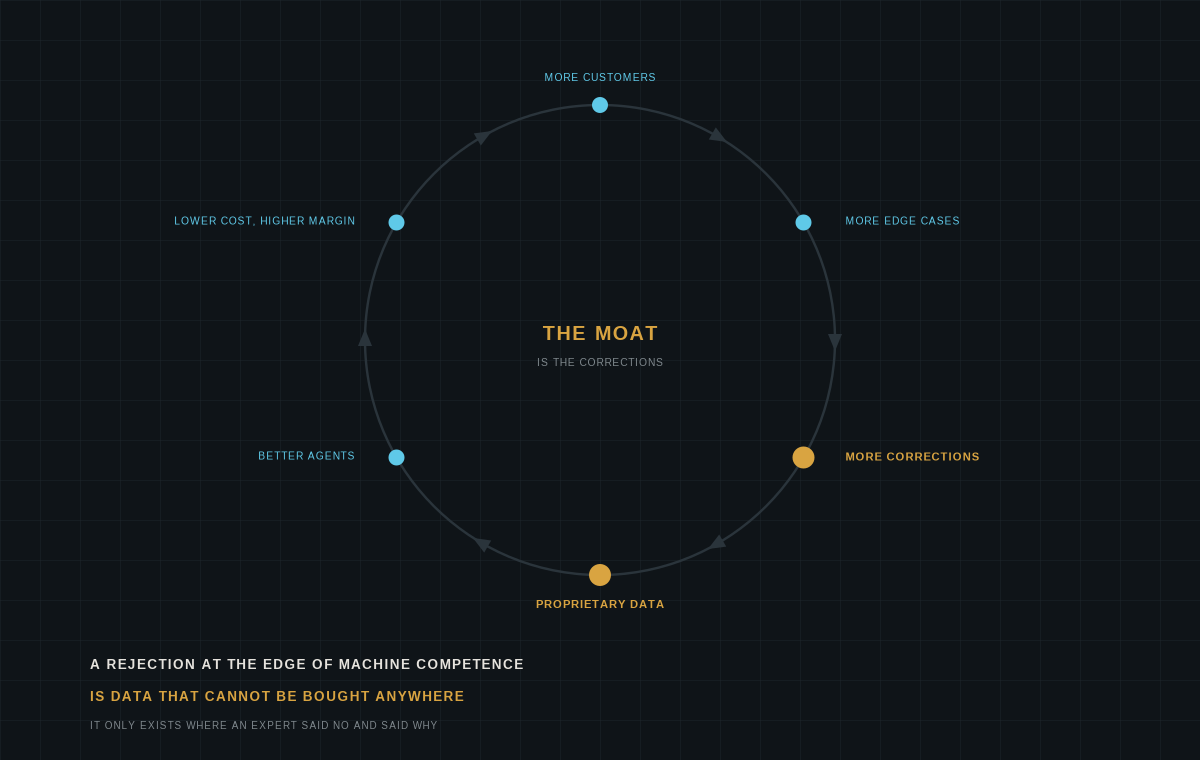
The corrections are the asset.
Two moats, and the second is the one that compounds. The first is a pool of people that takes years to build. The second is what those people produce every day.
- 01
Supply moat
A curated pool of German-speaking sector veterans. An offshore team can be booked in a week; this cannot.
- 02
Data moat
Corrections at the exact edge of machine competence — the only training data a larger competitor cannot simply buy.
- 03
Compliance moat
Works agreements, oversight records, the labour-law boundary. Slow, unglamorous, and routinely underestimated by fast entrants.
- 04
It gets deeper, not cheaper
Every month of operation adds corrections. Cost advantages erode; a decision record does not.
11 Competition
Why doesn't someone bigger just do this?
The honest form of the question is: why has nobody hired five thousand reviewers already? Four answers, and one of them is uncomfortable.
- 01
AI vendors do not want the liability
Owning the outcome turns a software gross margin into a service one. Their investors bought the former. Taking the ten per cent in-house is a story they cannot tell.
- 02
BPO providers optimise the wrong variable
Their model rewards more billable hours. Ours rewards fewer. A business whose margin improves when its people work less is not a business a BPO wants to become.
- 03
Expert networks sell advice, not decisions
An hour of consultation is not a signed decision inside a workflow, and it carries no record. Different product, different buyer, different liability.
- 04
The customer could do it himself — and cannot staff it
This is the uncomfortable one. The answer is not that it is impossible; it is that the retired specialist will work eight hours a week for a specialist operator and will not come back to his old employer to do it.
What moved since August
The category has a name now. On 14 October 2026 a16z described long-running agents for multi-week journeys, insurance claims explicitly among them, and three ways to sell them: as a platform, as a service or full-stack. Escalation to existing teams is mentioned; how the oversight works is not. RESERVE is the service route with the oversight as the product.
Capital flows to software. Parloa raised at a $3 billion valuation and Decagon at $4.5 billion in January 2026; Causa Prima closed a $20 million seed in October for back-office agents. Shift Technology launched agentic claims software in 2025, with the claims handler as user, not as a service.
The knowledge-retention story is taken — as software. Ergo's innovation lab and Google Cloud framed the retirement of insurance experts as a job for self-evolving agents in July 2026. We think the corrections only exist where an experienced person is still in the loop and says why.
Retiree pools exist, as marketplaces. Sentaris places more than 300 pensioners as freelancers; the Senior Experten Service has over 14,000 volunteers. Neither sells a signed decision inside a workflow, and freelancers fall outside the Aktivrente.
Sources: a16z; Taylor Wessing on Parloa; Bloomberg on Decagon; tech.eu on Causa Prima; Shift Technology; Cash.Online on Ergo and Google; Personalwirtschaft on Sentaris; SES.
12 What is proven
Nothing yet. Here is what would count, and by when.
Concept stage, stated plainly. The alternative is a deck that implies traction it does not have, which survives exactly one reference call.
| Milestone | Counts as proven when | State |
|---|---|---|
| Supply exists | 20 retired specialists interviewed, 10 say yes to eight hours a week | Not started |
| Pain is real | 6 heads of claims operations interviewed, 4 name the same bottleneck | Not started |
| Someone will pay | 2 letters of intent for a single-role pilot | Not started |
| The model holds | 1 pilot run for 90 days, escalation rate measured, not assumed | Not started |
| The boundary holds | Employment counsel signs the service-contract structure | In preparation |
These are the numbers we will report next, whether or not they are flattering.
13 Team and ask
What we have, and what we are missing.
Written this way because the gaps are the useful part.
What we have
Access and method
Arne Eilers, formerly COO, de:hub Security & Defense (BMWE): business development in regulated and dual-use industries, a working network of German operators and institutions, and a family of concepts built on the same idea: accountability enforced, not asserted.
What we need
Two people
A technical co-founder who has run agent orchestration with human handover in production, and an operations lead who has managed a claims department and knows which files are actually simple.
The ask
One pilot, not a round
A single insurer willing to run one role for ninety days. Funding follows a measured escalation rate. Anything before that is a bet on a slide.
14 Evidence room
Regulation, risk, and the three things that would kill this.
Kept short and kept here rather than in the pitch, because it belongs in diligence.
How to read every claim on this page
- Verified We read the instrument or measured it ourselves.
- Reported Named and credible, primary source unchecked.
- Our reading Our interpretation or our model. Argued, not measured.
A company selling accountable oversight has to be accountable about its own claims.
Regulation Reported
The human layer is demanded, not mandated
The Digital Omnibus, in force since 27 July 2026, moved the AI Act's high-risk duties to 2 December 2027, and the Commission's draft guidelines do not count claims management as high-risk. What applies: Art. 22 GDPR on purely automated decisions with significant effect, unchanged while the GDPR part of the omnibus is stalled in Council; and since 2 August 2026 Art. 50 — an ON CALL assistant has to say that it is a machine. We sell the person because customers and risk functions want one, not because a deadline forces it.
Works councils Our reading
They can stop a rollout
In Germany a system merely capable of monitoring performance triggers co-determination, regardless of intent. We expect to arrive with a model works agreement in hand — otherwise every customer costs six months before anything runs.
The boundary Under review
Service, not labour leasing
If the customer can direct our people, this becomes labour leasing, contracts become void and employment relationships are imposed by law; since the 2017 reform a standby licence no longer protects against that. It is why our supervisors are unreachable by the customer, why direction and quality responsibility stay with us, and why counsel reviews the structure before anything is sold.
- 01
Seniority alone is not a safeguard
Reviewers wave things through. In one study, experienced radiologists given wrong AI hints fell from 82 to about 46 per cent accuracy. Oversight has to be designed as a process — known test cases mixed into the queue, rotation, a time budget per case — or it becomes a rubber stamp with a pension. That design is part of the product, and part of what the pilot measures.
- 02
Three things we are testing now
Will retired specialists actually do this work, or do they want to advise rather than review? Does decades of experience materially outperform a trained reviewer at a third of the cost? And can the service structure be held outside labour leasing? A no to any of the three ends the concept, and we would rather find it in a kitchen than in a boardroom.
Sources: Lewis Silkin; William Fry; PPC Land on the GDPR omnibus; Handwerksblatt on the 2017 AÜG reform; Corporate Compliance Insights on automation bias.
15 Contact
One insurer, one role, ninety days
For heads of claims operations, employment counsel, investors — and for anyone recently retired who reads this and thinks they could do it better than the machine.
Concept stage · English or German · Munich, European Union